
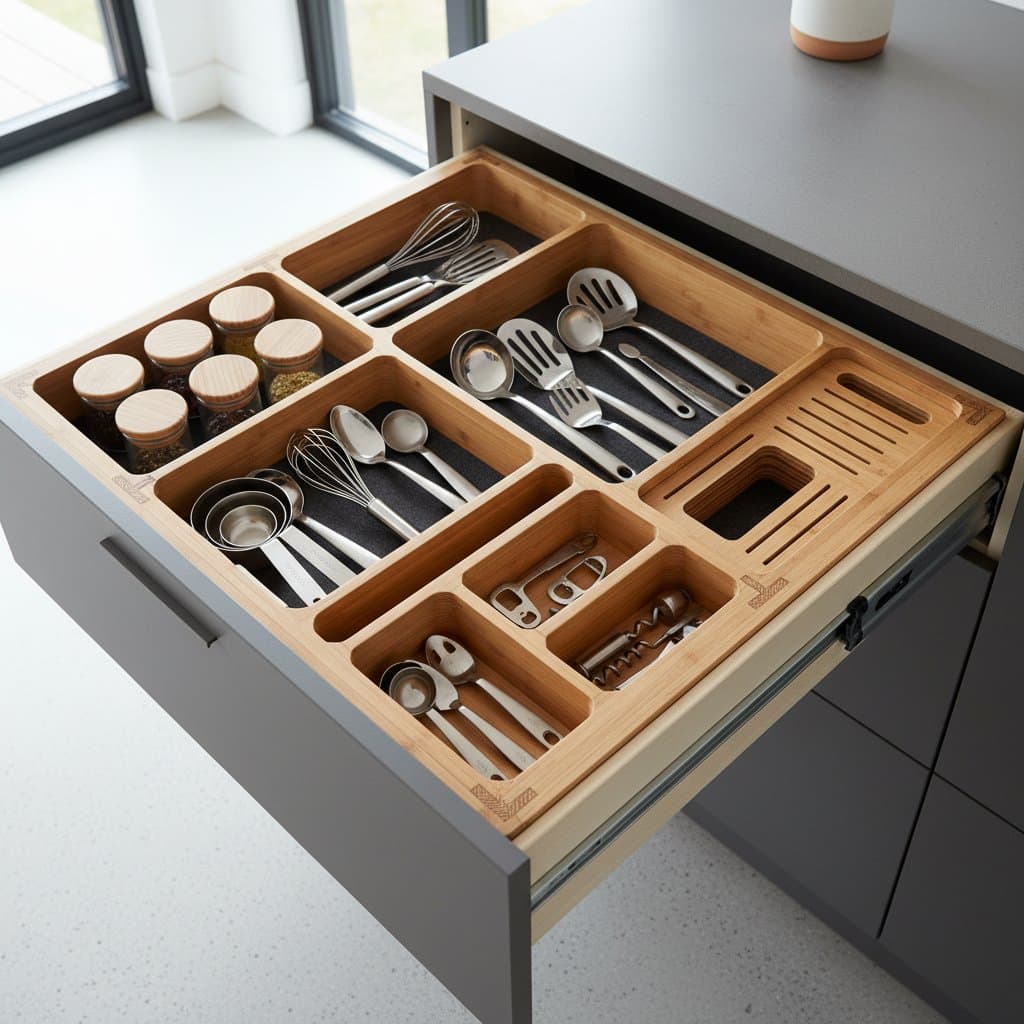
How CNC Inserts Revolutionize Drawer Storage
Drawer interiors once served as overlooked areas in cabinetry designs. They concealed disorder behind polished exteriors but provided little internal structure. The introduction of CNC-cut inserts has altered this dynamic. These meticulously crafted organizers convert drawers into efficient, bespoke systems that utilize every available inch. Machine tooling precision now enhances practical storage solutions.
This article examines the transformation brought by CNC inserts to woodworkers, designers, and homeowners. It highlights how layout planning, modular components, and material selection create organized spaces with enduring strength.
Overview of Applications
Primary users: Cabinetmakers, kitchen designers, and homeowners enhancing existing installations.
Common locations: Kitchens, workshops, offices, and vanity areas.
Standard dimensions: Compatible with drawers ranging from 12 to 48 inches (30 to 122 centimeters) in width.
Notable design firms: Studio Line Design, MapleWorks Fabrication, and Precision Interiors.
Image credits: Alex Ruiz and Jordan Kim.
Challenges of Traditional Approaches
Conventional drawer configurations depended on standard trays or movable dividers. Such options sufficed for basic items like silverware but fell short for intricate tasks or diverse tools. The core issue lay in scalability and compatibility. Pre-made organizers seldom aligned with specific drawer measurements, resulting in unused spaces and unstable components.
Cabinetmaker Elena Torres observed, “We used to build one-off dividers by hand, but the tolerances were hard to maintain. Even a small mismatch made the drawer feel sloppy.”
Inaccurate fits caused noise during use, accelerated deterioration, and fostered ongoing disarray. Professionals faced cumulative inefficiencies, while homeowners experienced recurring clutter despite efforts to organize.
Benefits of CNC Implementation
CNC inserts introduce computer-aided precision to internal organization. Designers create layouts in CAD software, then cut pieces from plywood, hardwood, or composites for seamless installation. This yields a secure fit that appears integral, with the option for reconfiguration as requirements evolve.
The lead fabricator at Studio Line Design noted, “The machine cuts to a fraction of a millimeter, so we know every divider will meet the wall cleanly. It feels engineered, not improvised.”
Images of completed installations reveal precise connections, refined surfaces, and adaptable grids suitable for utensils or tools. These inserts integrate fully with cabinet frameworks, avoiding the detachment of add-on pieces. Uniform materials and balanced proportions further improve the overall spatial harmony.
Essential Design Elements
- Material selections: Baltic birch plywood, laminate-faced MDF, or solid maple treated with protective oil.
- Connection methods: Finger joints or CNC-machined tabs that secure with limited adhesive for straightforward disassembly.
- Surface treatments: Clear coatings to preserve natural wood hues, matte paints for visual distinction, or anodized aluminum for robust environments.
- Layout configurations: Flexible grids, sloped compartments, or upright channels for items such as knives, chisels, and components.
- Advanced inclusions: Built-in labels, channeled routes for cables, and concealed magnets to secure tools.
Designs originate from adaptable digital templates that permit resizing or duplication. Fabricators adjust for varying depths or incorporate detachable sections for tools used seasonally or for specific purposes.
Enhancing Storage Capacity
A thoughtfully designed CNC insert boosts effective drawer volume by 25 to 40 percent. Dividers aligned to item sizes remove inefficient areas. In kitchen settings, one drawer accommodates all utensils visibly without overlap. Workshops benefit from accessible small parts, minimizing search times.
Integrating Illumination and Materials
Combined with under-cabinet LED lighting, CNC inserts offer enhanced functionality. Illumination highlights edges and exposes contents clearly. Designers often route low-voltage conduits into side panels, concealing wires while maintaining tidy appearances. This combination produces a inviting, utilitarian, and contemporary effect.
Photographer Jordan Kim documented a walnut-lined drawer where machined slots align with wood grain. The outcome proves both practical and engaging to the touch. The arrangement directs attention across the interior, underscoring the skill in cabinet construction.
Innovations Propelling Adoption
1. Consistent Digital Production
Successful layouts achieve endless replication. Small operations maintain file libraries for clients, facilitating prompt updates. This approach ensures uniform branding and accelerates workflows. Homeowners gain cohesive organization across drawers, simplifying intuitive access.
2. Adaptable Modularity
CNC inserts avoid permanent fixation. Designs frequently incorporate extractable blocks or gliding panels. As inventories shift, arrangements modify without full reconstruction. Such versatility prolongs cabinet longevity, accommodating lifestyle changes.
3. Accurate Material Handling
CNC technology enables precise cuts in resilient substances, eliminating manual adjustment challenges. Options like dense laminates, phenolic boards, or recycled hardwoods become feasible. These withstand humidity and abrasion, suiting demanding areas like kitchens and workshops.
4. Eco-Friendly Manufacturing
Nesting algorithms in CNC software optimize sheet usage, reducing scraps. Remainder pieces repurpose for minor components or prototypes. This method conserves resources and time, supporting sustainable custom work.
5. Compatibility with Intelligent Features
Advanced workshops connect inserts to automated lighting or electronic tags. LEDs illuminate upon drawer access for better sightlines. QR labels link to inventories, aiding tool or part monitoring. These elements elevate organization to smart, responsive levels.
Implementing CNC Organization at Home
Homeowners without dedicated facilities can still adopt CNC principles. Online services allow dimension uploads and template choices, delivering flat-packed inserts for easy assembly.
Follow these steps:
- Measure accurately. Note interior width, depth, and height to the millimeter.
- Outline arrangements. Categorize items by function or access frequency.
- Select materials. Opt for plywood to convey warmth, laminates for simple maintenance, or metals for resilience.
- Incorporate lighting. Install slim LED strips to brighten interiors.
- Account for tolerances. Provide at least 1/16 inch (1.5 millimeters) clearance per side for fluid movement.
Local fabricators with CNC capabilities offer rapid prototyping from surplus materials, enabling affordable trials before larger orders.
Core Advantages
- CNC inserts provide exact-fit systems that eradicate disorder and underutilized areas.
- Digital methods support repeatable, expandable designs for bespoke and volume production.
- Modular builds permit adjustments to match shifting demands.
- Fabrication processes cut waste and foster eco-conscious innovation.
- Lighting and tagging features enhance accessibility and systematic use.
CNC inserts mark a progression from ad-hoc storage to structured performance. They position drawers as purposeful aids in routine activities.
Preserving Longevity
Maintain inserts by cleaning with a moist cloth, avoiding excess moisture to safeguard joints. Apply wood glue or replace tabs if components shift. For movable setups, ensure tracks stay clear of particles.
Periodic rearrangements leverage the precise construction without harm. Durable coatings extend insert lifespan alongside the cabinet.
Experiencing the Transformation
Installation yields instant improvements: effortless opening, stable contents, and designated spots for all items. This tranquility extends to surrounding areas. Homeowners often cite the resulting composure as a renovation highlight.
The rise of CNC inserts signifies a commitment to deliberate, precision-based artistry that balances technical excellence with practical application.