
Japandi Joinery: Concealing Craftsmanship for Seamless 2025 Cabinetry
Japandi design principles extend beyond furniture and floors into cabinetry, where Japanese precision meets Scandinavian comfort. This fusion shapes kitchens, bathrooms, and built-ins that prioritize tranquility alongside ample storage. Joinery techniques now emphasize concealing intricate mechanisms behind smooth surfaces, ideal for compact homes and open layouts that demand both efficiency and visual harmony.
Project Overview: Family Home in Seattle
Residents: Professional couple with two young children
Location: Seattle
Footprint: 1,480 square feet (137 square meters)
Design Firm: Atelier Noma
Photographer: Clara Jensen
The homeowners sought expanded storage without sacrificing openness in their kitchen and hallway. These areas needed to function as pantry, mudroom, and display space while preserving clear sightlines. Atelier Noma applied Japandi joinery to integrate utility and serenity seamlessly.
Original Layout Challenges
Builder-grade cabinets and cluttered open shelves dominated the initial kitchen. Uneven door fronts disrupted flow, and the tight configuration hindered movement during meal preparation. One homeowner noted, "We had abundant natural light but lacked any sense of organization. Every item seemed perpetually on display."
Transformed Design
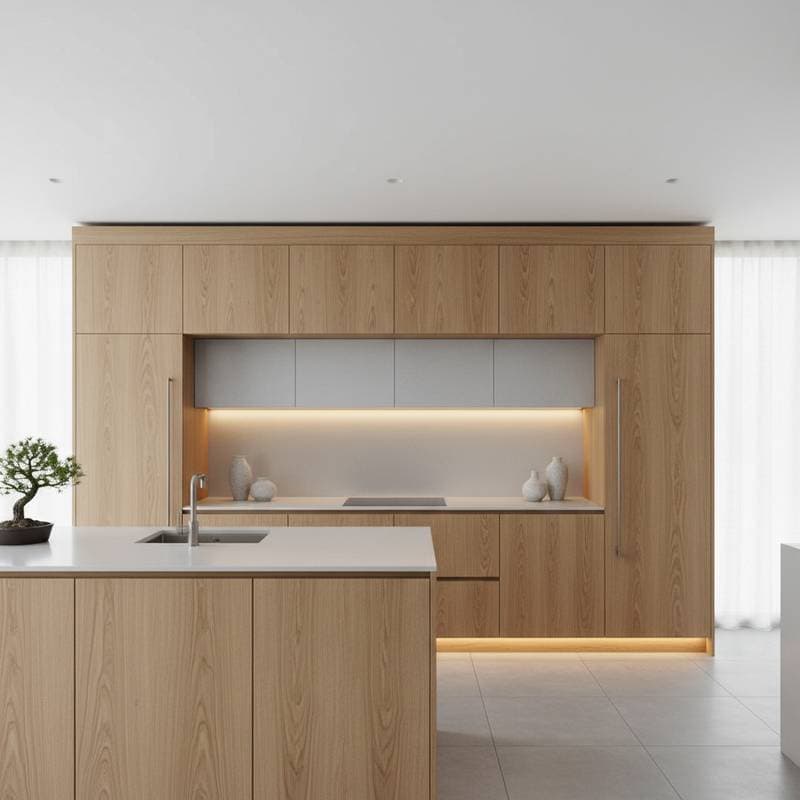
A unified wall of floor-to-ceiling cabinets now anchors the space, providing storage and structural support. Doors align in uninterrupted vertical planes, with concealed finger pulls eliminating visible hardware. The joinery ensures surfaces remain flawless, allowing light to skim across them without snagging on edges.
Oak veneer grain continues seamlessly over tall doors, complemented by matte lacquered panels for subtle variation. A recessed plinth elevates the unit slightly, facilitating cleaning underneath. This setup resembles bespoke furniture more than standard cabinetry. Lead designer Noriko Yamazaki explained, "We aimed for joints that convey composure. Effective joinery vanishes because it performs flawlessly."
Core Elements
- Materials: Quarter-sawn white oak veneer unified across panels, matte white lacquer highlights, and solid oak pulls beveled at 45 degrees for secure handling.
- Hardware: Concealed hinges supporting 125-degree openings, soft-close drawer slides with built-in dampers, and magnetic catches for doors.
- Interior Organization: Full-extension pull-out pantries with tiered trays, customizable dividers for pantry staples, and a discreet charging station featuring cord access.
- Illumination: 2700K undercabinet LED strips for task lighting, paired with internal recessed pucks in upper sections for gentle ambiance.
- Joinery Methods: Dovetail reinforcements at drawer edges, finger-jointed oak frames supporting veneer doors, and mortise-and-tenon assemblies for shelf brackets.
Vertical and horizontal lines guide the eye, delineating zones at comfortable heights. Tall doors frame the cooking station, while shallower uppers align above the counter. Precise joinery maintains sharp transitions throughout.
The Value of Japandi Joinery
This approach unites Japanese geometric purity with Scandinavian utility, preferring robust joints to mechanical fasteners for enhanced stability and reparability. The outcome yields lighter, more engaging surfaces. Woodworkers appreciate the emphasis on meticulous technique, while residents benefit from versatile pieces that transition smoothly between rooms.
Invisible hardware and flowing grain patterns address contemporary lifestyles in visible kitchens. Open plans require subdued visuals, which Japandi achieves via balanced proportions and minimal embellishment.
Compact Kitchen Redesign: Copenhagen Apartment
Location: Copenhagen
Design Firm: Studio Lykke
Photographer: Jonas Rehn
Studio Lykke reimagined a slender galley kitchen as an efficient, fluid area using unbroken ash panels with embedded handles. A standout feature is a sliding screen of wooden slats that conceals appliances, promoting ventilation without exposing disorder. Designer Maja Lykke stated, "Our vision was a kitchen akin to finely wrought furniture."
Essential adaptations include:
- Sliding Slat Mechanism: Interlocking half-lap joints enable trackless gliding.
- Finish and Hue: Pale ash treated with white oil to amplify brightness in confined quarters.
- **Storage ** Deep drawers supplanting lower cabinets, boosting accessibility by 40 percent over traditional doors.
Light-toned wood and refined joints infuse warmth and structure, rendering the space understated yet inviting.
Serene Bathroom Vanity: Vancouver Retreat
Location: Vancouver
Design Firm: Forma Studio
Photographer: Dean Halberg
Forma Studio crafted a suspended vanity in this bathroom that incorporates linen storage behind a rhythmic slatted facade. Chamfered vertical elements capture light, accentuating the wood's texture while masking drawer divisions.
Notable features:
- Unified Drawer Facades: Vertical ribs obscure seams, secured by hidden dowels and glue-block reinforcements.
- Storage Solutions: Three substantial soft-close drawers for linens and essentials, plus a lateral compartment for supplies.
- Lighting Arrangement: Flanking wall sconces with the mirror, augmented by cove illumination beneath the vanity for even light distribution.
The design promotes relaxation and practicality, where each joint contributes to both form and fortitude, introducing subtle pattern sans added fixtures.
Incorporating Japandi Joinery into Your Space
Adopt these principles incrementally, even in partial updates, by focusing on balance and accuracy. The intent is serene simplicity, achieved through deliberate choices.
Streamline Front Panels
Select flat panels over decorative edges, opting for genuine wood veneers or solid stock with pronounced grain. Align grain vertically or horizontally for a soothing continuity that unifies the composition.
Hide Mechanisms
Incorporate edge-carved finger grooves or recessed grips to maintain flush profiles. Ensure uniform spacing and consistent gaps between elements for polished alignment.
Integrate Warm Lighting
Pair task-oriented undercabinet fixtures with diffused overhead sources. Select 2700K tones to soften the pared-down scheme.
Select Authentic Finishes
Embrace natural woods, subdued mattes, and exposed joints to highlight skilled work. Steer clear of faux grains in laminates; the genuine touch of wood enhances sensory appeal.
Harmonize Patterns and Shades
Direct grain consistently across faces, limiting to one or two allied tones. This discipline underpins the style's repose.
Prioritize Quality Construction
For DIY projects, hone dovetails and finger joints on test pieces. When commissioning, specify solid edge banding and mortise-and-tenon frames for enduring results.
Essential Insights
- Fluid Aesthetics: Unbroken patterns and obscured connections suit expansive interiors.
- Longevity: Time-tested joints bolster resilience and extend service life.
- Adaptability: Subtle palettes and sparse hardware enable seamless integration across rooms.
- Organized Serenity: Intelligent internals behind plain exteriors streamline routines.
Japandi joinery emphasizes purposeful construction over stark minimalism. Precision in every connection fosters intentional environments that endure.
Sustaining the Craft
Japandi cabinets require minimal upkeep, centered on material preservation. Apply oil periodically to wood for sustained vibrancy. Realign hidden hinges as needed to uphold precision. Balance lighting to accentuate textures and details effectively.
This refined approach proves that cabinetry can harmonize utility with elegance. Through exacting joints and considered scale, spaces emerge that accommodate abundantly while revealing sparingly.